USM Hosted the Third Edition of the Conference “The Survival of Constitutional Tradition in the Patterns of European Constitutionalism”
On March 27, 2026, Moldova State University hosted the third edition of the national scientific conference with international participation, “The Survival of Constitutional Tradition in the Patterns of European Constitutionalism”—a major academic event that brought together researchers, university professors, doctoral candidates, legal practitioners, and representatives of the scholarly community from the Republic of Moldova, Romania, and Poland for a substantial and timely dialogue on the fate of European constitutionalism in the face of contemporary challenges.
The conference was organized by the Department of Public Law of the Faculty of Law of Moldova State University and the Research Laboratory for Comparative Public Law and E-Governance, in cooperation with prestigious academic institutions and partners, including the Institute of Legislative Creation and Comparative Law, the Romanian Association of Constitutional Law, the “C.S. Nicolăescu-Plopșor” Institute of Social Sciences and Humanities in Craiova, the Institute for the Development of the Information Society, and the Regional Centre for Social Initiatives and Sustainable Development.
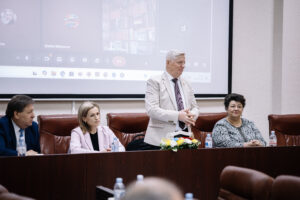
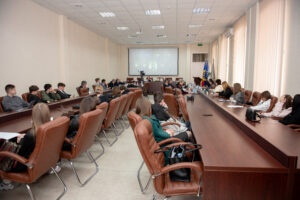
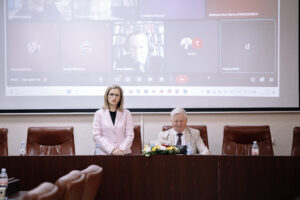
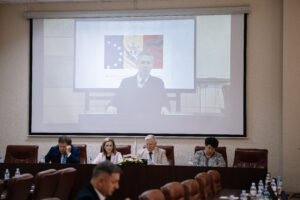
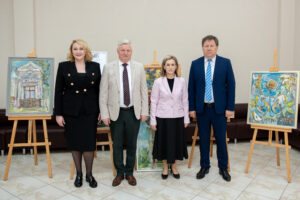
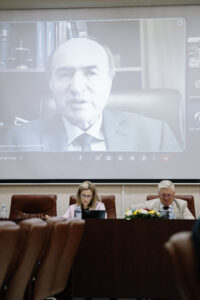
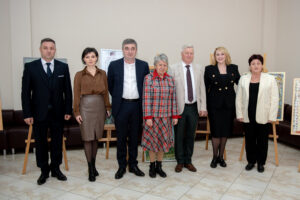
Held in a hybrid format in the “Victor Volcinschi” Conference Hall of Moldova State University, the event once again confirmed the vocation of academia to build lasting bridges between tradition and innovation, between doctrinal reflection and the legal realities of the present. From the outset, the conference fostered an atmosphere of intellectual openness and interdisciplinary dialogue, complemented by the painting exhibition “For Peace”, signed by visual artist Iraida Ciobanu, Doctor of Arts and Lecturer at the “Ion Creangă” State Pedagogical University of Chișinău, an exhibition that symbolically accompanied the entire day of proceedings.
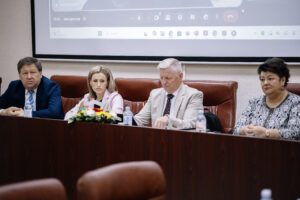
The opening ceremony brought together prominent figures from academic and legal life, including Georgeta Stepanov, Vice-Rector of Moldova State University; Sergiu Băieșu, Dean of the Faculty of Law of Moldova State University; Marieta Safta, President of the Romanian Association of Constitutional Law; Sevastian Cercel, Director of the “C.S. Nicolăescu-Plopșor” Institute of Social Sciences and Humanities of the Romanian Academy, Craiova; Jacek Zaleśny, Associate Professor at the University of Warsaw; and Rodica Ciobanu, Head of the Department of Public Law of the Faculty of Law of Moldova State University. The proceedings were moderated by Academician Ion Guceac.
The plenary session, held under the theme “The Constitution – a Pillar for Safeguarding the Common Good and Fundamental Human Rights in the Context of Current Challenges”, was one of the central moments of the conference. The presentations delivered by Cristian Ionescu, Jacek Zaleśny, Marieta Safta, Ion Guceac, Tudorel Toader, Sevastian Cercel, Gheorghe Cojocaru, Rodica Ciobanu, Andy Pușcă, Liana-Teodora Pascariu, and Lucian-Sorin Stănescu brought to the fore issues of the utmost relevance, including the liberal constitutional state, the regression of the rule of law in the European Union, judicial dialogue between constitutional courts and European courts, the legal protection of the Constitution, legislative omission, the relationship between supremacy and primacy within the European legal order, European integration in the digital age, and the balance between public oversight and economic freedom.
A distinct moment in the programme was the launch of the proceedings volume of the conference’s second edition, held on March 28, 2025, a gesture that underscored the continuity and consolidation of this scholarly forum. In this way, the conference reaffirmed not only its vocation as a space for academic debate, but also its editorial dimension, aimed at promoting and integrating doctrinal contributions into the broader scientific circuit.
In the second part of the day, the proceedings continued within Panel I, dedicated to the theme “Civil Society – a Reforming Force of Constitutionalism”, moderated by Professor Rodica Ciobanu and Professor Elena Aramă. The papers presented highlighted, from various perspectives, the role of civil society, case law, and democratic mechanisms in the dynamics of constitutional reform and in strengthening the rule of law. Topics addressed included justice as a constitutional value, national identity and constitutional identity, the protection of corporate assets through constitutional jurisprudence, freedom of conscience in the digital age, lobbying activities in contemporary parliaments, the modernization of the Constitution of the Republic of Moldova in the context of European integration, the constitutionalization of the principles of the circular economy, and parliamentary mechanisms for ensuring the well-being of the population.
At the same time, the work of Panel II, entitled “Democratic Values – a Pillar of Twenty-First-Century Constitutionalism”, took place in two thematic workshops: Workshop 1, moderated by Rodica Nichita and Doina Cuciurca, and Workshop 2, moderated by Cristina Popovici and Olga Ceban. The papers considerably broadened the field of reflection, exploring the relationship between democratic values and twenty-first-century constitutionalism, with a focus on local referendums, administrative litigation, democratic hybridity, civic participation in urban planning, the right not to be sanctioned more than once in contraventional proceedings, current trends in the regulation of the justice sector, good governance in the electoral field, the independence and accountability of magistrates, fundamental rights in the digital era, environmental protection through sustainable public procurement, and the modernization of juvenile criminal justice.
The thematic diversity of the presentations was accompanied by remarkable conceptual coherence. Beyond the plurality of subjects, most contributions converged around several essential questions: how the supremacy of the Constitution can be defended in an era marked by the acceleration of political and technological decision-making; how fundamental rights can be protected in the face of new forms of vulnerability; and what place constitutional tradition occupies in a European context increasingly shaped by interdependence, judicial dialogue, and permanent institutional reform.
Through the rigour of its programme, the quality of its presentations, and its openness to international cooperation, the third edition of the conference established itself as a landmark event in the academic and legal landscape of 2026. Organized within the framework of the project “Strengthening the Socio-Economic and Legal Mechanisms for Ensuring the Well-Being and Security of Citizens” (CONSEJ 01.05.02), the conference reaffirmed that reflection on the Constitution, the rule of law, and fundamental rights remains one of the most relevant forms of intellectual engagement in the present day.